Table of Contents
ToggleTiny house living demands every square foot to count, and stairs are often the biggest space hog in a compact floor plan. A standard residential staircase consumes roughly 50–60 square feet per floor it connects, a massive bite out of a 400-square-foot home. The good news: smart stair design can reclaim that wasted volume while adding character and functionality. Whether you’re building a tiny home from scratch or retrofitting an existing space, understanding your options, from spiral stairs to loft ladders, lets you choose the design that matches your layout, budget, and lifestyle. This guide walks through the most practical tiny house stair solutions, installation considerations, and cost realities homeowners face in 2026.
Key Takeaways
- Tiny house stairs can reclaim wasted space through smart design choices like spiral stairs, L-shaped layouts, or under-stair storage that recover 20–30 square feet.
- Building codes require a minimum 6 feet 8 inches of headroom and riser heights between 7–7.75 inches; verify local requirements before designing your tiny house stairs to avoid costly rework.
- Spiral stairs fit compact 4-by-4-foot footprints starting at $800 for prefab metal options, while loft ladders ($200–$800) offer even more minimal space use for secondary access or sleeping lofts.
- DIY installation is realistic for prefab metal spirals and loft ladders (4–6 hours with basic tools), but custom wood staircases demand professional carpentry skills and 40–60 hours of labor.
- Paired with under-stair storage or integrated as functional design features, well-planned tiny house stairs transform space constraints into opportunities for character and efficiency.
Understanding Space Constraints in Tiny Homes
Tiny houses typically define themselves as homes under 500 square feet, with many hovering around 300–400 square feet. A conventional 3-foot-wide staircase with a 10-foot run eats significant real estate. The issue isn’t just floor area, it’s vertical clearance, headroom codes, and how the stair placement locks adjacent spaces into their layout.
Building codes (the International Residential Code, or IRC, varies by region) require at least 6 feet 8 inches of headroom in stair wells. That’s non-negotiable for safety and resale value. Stairs also need a riser height between 7 to 7.75 inches and a tread depth of at least 10 inches on the run. These seem like minor tweaks, but when you’re working with tight floor plans, they force difficult trade-offs: narrower hallways, smaller bedrooms, or reduced living-room size.
The silver lining is that clever design, whether you choose an angled staircase, a spiral model, or even a loft ladder, can transform a space constraint into a design feature. Understanding your home’s height between floors, the footprint you can dedicate to stairs, and local code requirements is the first step before settling on any solution.
Vertical Space Maximization Strategies
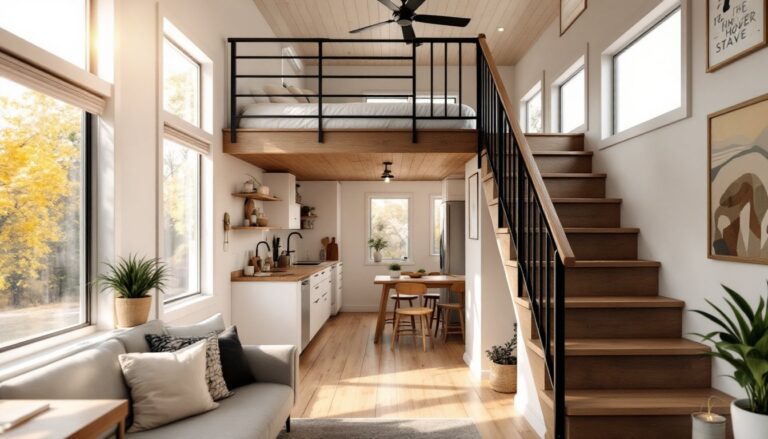
Once you’ve mapped your headroom and floor plan, maximize every angle of your staircase. One proven strategy is to pair stairs with under-stair storage. A small closet, shelving unit, or even a mini pantry tucks seamlessly beneath an angled stair run, recovering 20–30 square feet. Open-riser stairs (where the stair treads sit on stringers but have no closed backs) also reduce visual bulk and let light flow through, making the space feel less cramped than a traditional enclosed staircase.
Angled staircases, those that turn 90 or 180 degrees, often fit tighter footprints than straight runs. A switchback or L-shaped stair uses half the linear floor space by folding back on itself. If your ceiling height allows, this trade-off is often worth it. Some tiny house builders also incorporate landings as mini work surfaces or additional seating, adding functional square footage.
Stair width matters too. A 36-inch-wide staircase is the IRC minimum for a single-family dwelling, but 30-inch staircases are permissible in some jurisdictions for accessory structures or secondary access (always verify local code). Shaving 6 inches from the width recovers roughly 50 cubic feet per staircase. Consult your local building department before designing to these minimums: some inspectors will challenge them.
Popular Stair Styles for Tiny Houses
Spiral Stairs and Compact Options
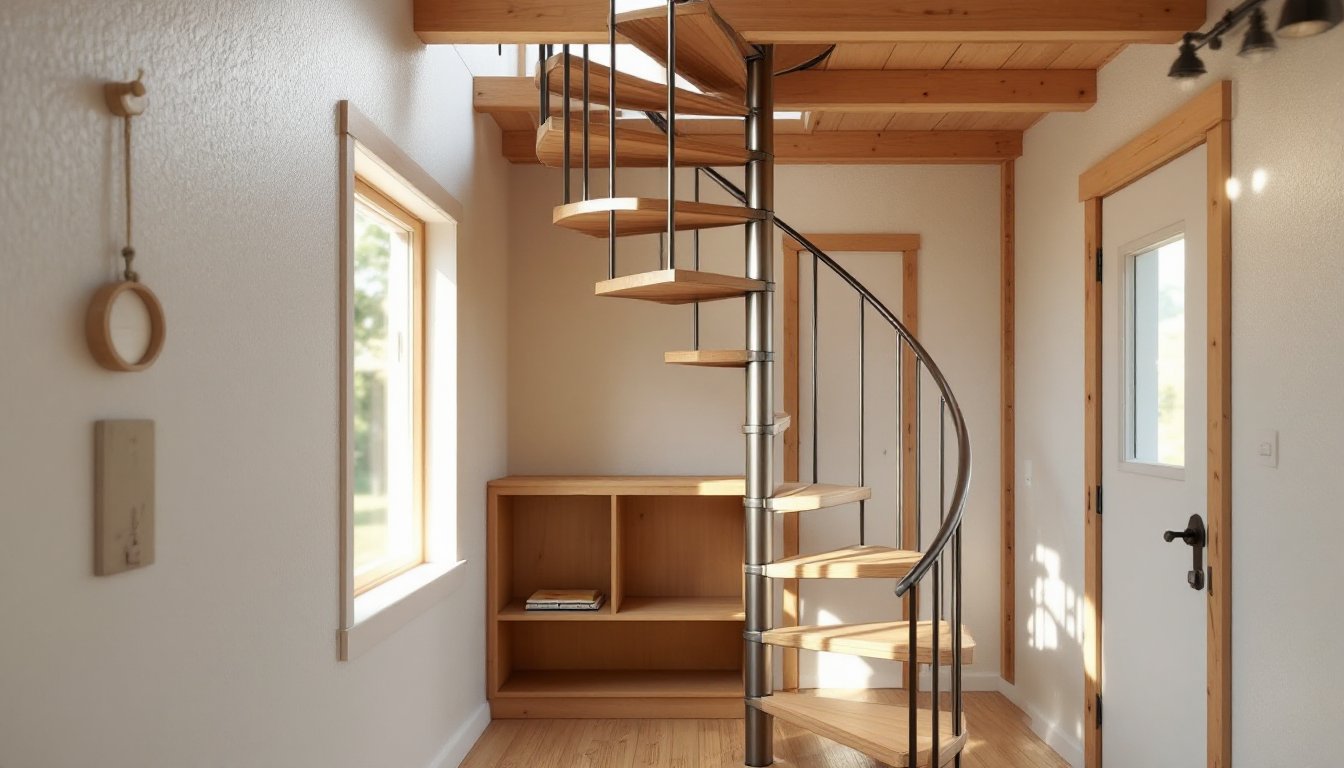
Spiral stairs pack a full staircase into a footprint as small as 4 feet by 4 feet, making them a darling of the tiny-house market. They work best when connecting lofts to main floors or when vertical space is plentiful but horizontal square footage is tight. The catch: spirals feel cramped if you’re carrying furniture upstairs, and some people find them disorienting or difficult to climb (especially children or older adults).
When shopping for spiral stairs, look at tread depth and rise height. Budget-friendly metal spirals often have narrow treads (6–8 inches) and steep rises, which slow the climb. Quality wood or composite spirals offer deeper treads (9–11 inches) and gentler angles, feeling less like a fire escape. Expect costs to range from $800 for basic prefab metal kits to $3,000+ for custom wood spirals, depending on materials and height.
Compact L-shaped and U-shaped staircases offer a middle ground. They preserve headroom, accommodate standard tread and riser dimensions, and fit into a 6-by-8-foot footprint or smaller with creative placement. The trade-off is that they require a landing at the turn, which eats a few square feet, but the payoff is a safer, more comfortable climb than a spiral.
Loft Ladders and Alternative Climbing Solutions
Not every upper space needs a full staircase. Loft ladders, sloped ladders (typically 70–75 degrees) that fold against a wall when not in use, occupy minimal footprint and cost $200–$800 for quality models. They’re ideal for accessing sleeping lofts or storage mezzanines in micro-cabins or RV-style tiny homes. The downside: they’re slower and trickier for daily commutes, and they’re not code-compliant as a primary exit in bedrooms (check your local inspector).
Mobile or rolling stairs (often called “library ladders”) offer another alternative. These sit on a rail system and slide out of the way when not in use. Some tiny-house builders integrate rolling stairs beneath windows or along one wall, turning them into a dual-purpose feature. These typically run $1,000–$2,500 and require solid wall framing and careful installation.
Analog alternatives like rope ladders or ship-style climbing ladders are tempting visually but rarely practical or code-friendly for primary residential access. If you’re considering non-traditional climbing solutions, run them past your local building department and insurer first. Many policies won’t cover a home with a non-code-compliant primary exit route.
DIY Installation Tips and Cost Considerations
DIY stair installation sits in a gray zone: simple spiral stair assembly or loft ladder mounting can be a weekend project, while custom wood stairs require serious carpentry chops. Here’s how to assess what’s doable and what needs a pro.
Pre-fabricated metal or composite spiral stairs are the most DIY-friendly. They typically arrive in sections (4–5 pieces) with bolts, washers, and instructions. You’ll need a helper, a tape measure, level, and a socket wrench set. The critical steps: verify floor-to-floor height (measure at least three points around the perimeter), ensure the base sits level and secure to the subfloor (use appropriate fasteners for your floor type), and check headroom clearance with a 2×4 joist once the unit is standing. Most installations take 4–6 hours.
Loft ladders and rolling stair systems require solid wall framing and precise fastening. You’ll need a stud finder, drill, 3/8-inch lag bolts (for bearing into studs), and a level. Don’t skimp on fasteners, these need to support full body weight under dynamic load. If your wall framing is questionable or if you’re mounting to drywall without adequate backing, hire a carpenter for $200–$400 to ensure it’s safe.
Custom wood stairs demand genuine carpentry. Calculating stringers (the angled supports), cutting dados or mortises, and fitting treads and risers require experience and precision tools, circular saw, miter saw, chisels, and sanders at minimum. Building and installing a custom 12-step staircase typically takes 40–60 hours and is best left to someone who’s done it before. Mistakes here are expensive and unsafe.
Cost reality: A prefab spiral staircase costs $1,500–$3,500 installed: a custom wood staircase runs $3,000–$8,000+, depending on wood grade, finish, and local labor rates. Loft ladders are typically $300–$1,000 installed. Always budget for shims, fasteners, and finish materials (stain, paint, or polyurethane), which add another 10–15% to the base cost. Get at least two quotes from local carpenters or stair specialists, prices vary wildly by region and material availability.
For DIY builders, Ana White offers free loft ladder and simple stair plans that scale to compact spaces. Apartment Therapy’s small-space galleries showcase real-world examples of how other tiny-house owners solved their stair challenges. If you’re fabricating wood stairs, Fix This Build That publishes detailed woodworking guides on stringer layout and assembly.
Safety checklist before you climb: Ensure stairs are anchored to the floor and (if attached to walls) to solid framing. Verify rise and run consistency across all steps, variation greater than 3/16 inch triggers code violations and tripping hazards. Install graspable handrails on at least one side if stairs are 4+ steps: this isn’t optional. Wear eye protection and dust masks during cutting and sanding: stair installation involves repetitive overhead work, so ear protection is wise if using power tools.
If you’re uncertain about local code, ask your building department for a pre-construction review. A 15-minute conversation beats a failed inspection and costly rework.
Conclusion
Tiny house stairs don’t have to be an afterthought. The right choice, whether a space-saving spiral, a compact L-shaped design, or a clever loft ladder, transforms a necessary evil into a functional and visually compelling feature. Start by measuring your floor-to-floor height, understanding local codes, and mapping your footprint. Then match the stair style to your layout, lifestyle, and budget. DIY is realistic for simpler prefab solutions, but don’t gamble with safety or code compliance. A staircase is a load-bearing element and a critical exit route, get it right the first time.